
The Armenia Project Brings Debate Over Media, Algorithms and AI to Concordia Annual Summit
Media leaders examined who holds power over public opinion as audiences increasingly turn to social platforms, independent creators and AI for news
Discussion explored declining trust in traditional media, the growing power of algorithms and the challenge of sustaining independent journalism in countries including Armenia
Panel brought together leaders from investigative, independent and traditional media to discuss accountability and the future of journalism
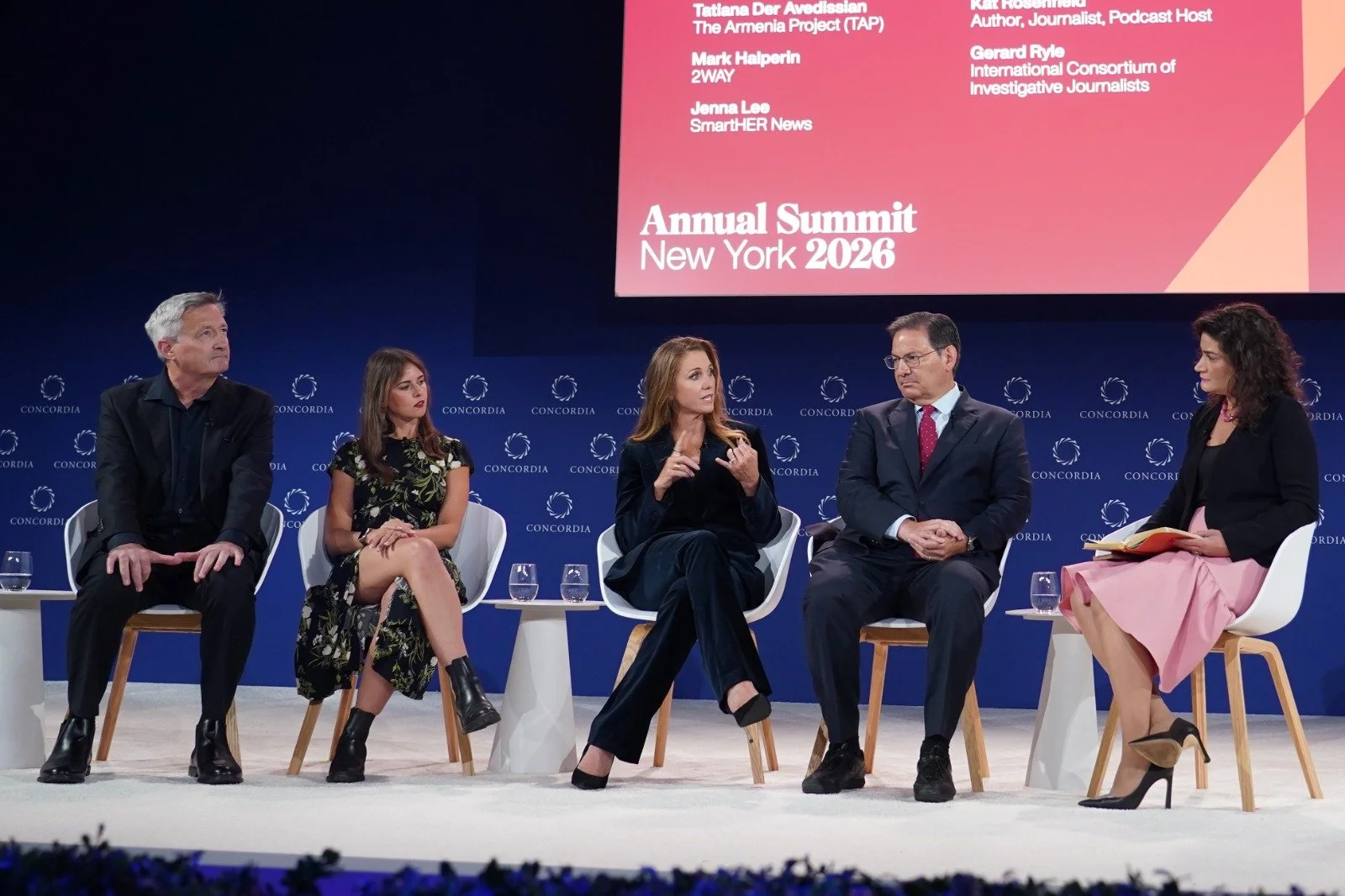
(L-R) Gerard Ryle, Executive Director, International Consortium of Investigative Journalists, Jenna Lee, Founder, SmartHER News, Kat Rosenfield, Author, Journalist, and Podcast Host, Mark Halperin, Editor-in-Chief, 2WAY, and Tatiana Der Avedissian, Board Member, The Armenia Project (TAP), speak onstage during the "From Headlines to Hashtags: Who Really Shapes Public Opinion?" session at the 2026 Concordia Annual Summit at Sheraton New York Times Square on September 21, 2026 in New York City. (Photo by [photographer name]/Getty Images for Concordia Annual Summit)
NEW YORK: The Armenia Project (TAP) brought together leading voices from traditional, independent and investigative media at the 2026 Concordia Annual Summit on September 21 for a wide-ranging discussion on a rapidly changing information landscape, and who now holds the power to shape public opinion.
The TAP-sponsored session, “From Headlines to Hashtags: Who Really Shapes Public Opinion?”, featured Gerard Ryle, Executive Director of the International Consortium of Investigative Journalists (ICIJ); Kat Rosenfield, writer for The Free Press; Jenna Lee, former Fox journalist and founder of SmartHER News; and Mark Halperin, Editor-in-Chief of 2WAY. The discussion was moderated by Tatiana Der Avedissian, Board Member and co-founder of The Armenia Project.
The conversation came as the balance of power in news continues to shift away from traditional gatekeepers. The Reuters Institute’s 2026 Digital News Report found that social media and video networks have overtaken legacy media as a way people access news globally, with 30% now saying social media and video are their main source of news, up from 20% in 2020. Panelists examined what that shift means for trust, accountability and the future of journalism — particularly as algorithms increasingly determine which voices reach audiences.
“The algorithms, the behavior of the algorithms as empowered by AI is easily number one, and I don't believe the government can control it, and I don't believe the private sector will,” Halperin said when asked whether journalists, influencers or platforms require greater scrutiny.
Lee argued that amid an increasingly crowded media environment, journalists must distinguish themselves through the standards behind their reporting.
“Journalists do not have a badge that they wear all the time or a uniform that establishes who they are in this really cluttered media landscape,” Lee said. “We really only have one thing when it comes to a license to practice and that's our integrity.”
That question of trust emerged throughout the discussion as panelists considered why audiences increasingly seek information from individual creators and independent outlets rather than established institutions.
“People say I want someone I trust and oftentimes that actually is someone, it is a person,” Rosenfield said.
But she also cautioned that personality-driven media brings its own challenges: “the type of personality that does really well in the attention economy is not necessarily the most diligent journalist.”
Artificial intelligence introduced another layer to the debate. Ryle said journalists must embrace useful technology while remaining alert to the risks it creates for accuracy, independence and control of information.
“The problem is that you can often misuse it and if you misuse it you end up getting your facts wrong and I think that's the biggest danger in journalism,” Ryle said.
He also warned that investigative journalists must be particularly cautious about sharing sensitive information with commercial AI systems.
The panel considered how these changes affect countries that have historically received limited sustained attention from international news organizations. Armenia served as one example of how digital platforms can give smaller local outlets access to global audiences while raising difficult questions about how independent journalism can remain financially sustainable.
“I think in Armenia and smaller places, what they need to do is look around to see what's working in other countries,” Ryle said, pointing to subscription-supported journalism in France and South Korea as examples of models that can support independent reporting.
Ryle also emphasized the importance of working with journalists who possess local knowledge rather than relying exclusively on traditional foreign-correspondent models.
“These days, what we try and do is a collaborative model where we actually work with reporters in each country,” Ryle said. “And we also listen to what they have to say, because I think you have to listen more than the old days.”
The discussion ultimately returned to a question facing news organizations, independent creators and technology platforms alike: whether the systems governing accountability have kept pace with the systems now determining what information reaches the public.
For The Armenia Project, the conversation also reflected a broader effort to connect Armenia to international debates over journalism, communications and the changing global information environment, while drawing attention to the opportunities and challenges facing independent media in smaller countries.
About The Armenia Project (TAP)
The Armenia Project is a nonprofit educational organization dedicated to advancing Armenia’s democratic and economic development by enhancing its communications ecosystem. Through storytelling, media engagement, and global partnerships, TAP brings international attention to urgent challenges while empowering civil society.
