
Through a high-level private roundtable and panel discussion, TAP brought international perspectives to questions around media censorship, the role of artificial intelligence, importance of public trust and the survival of independent media.
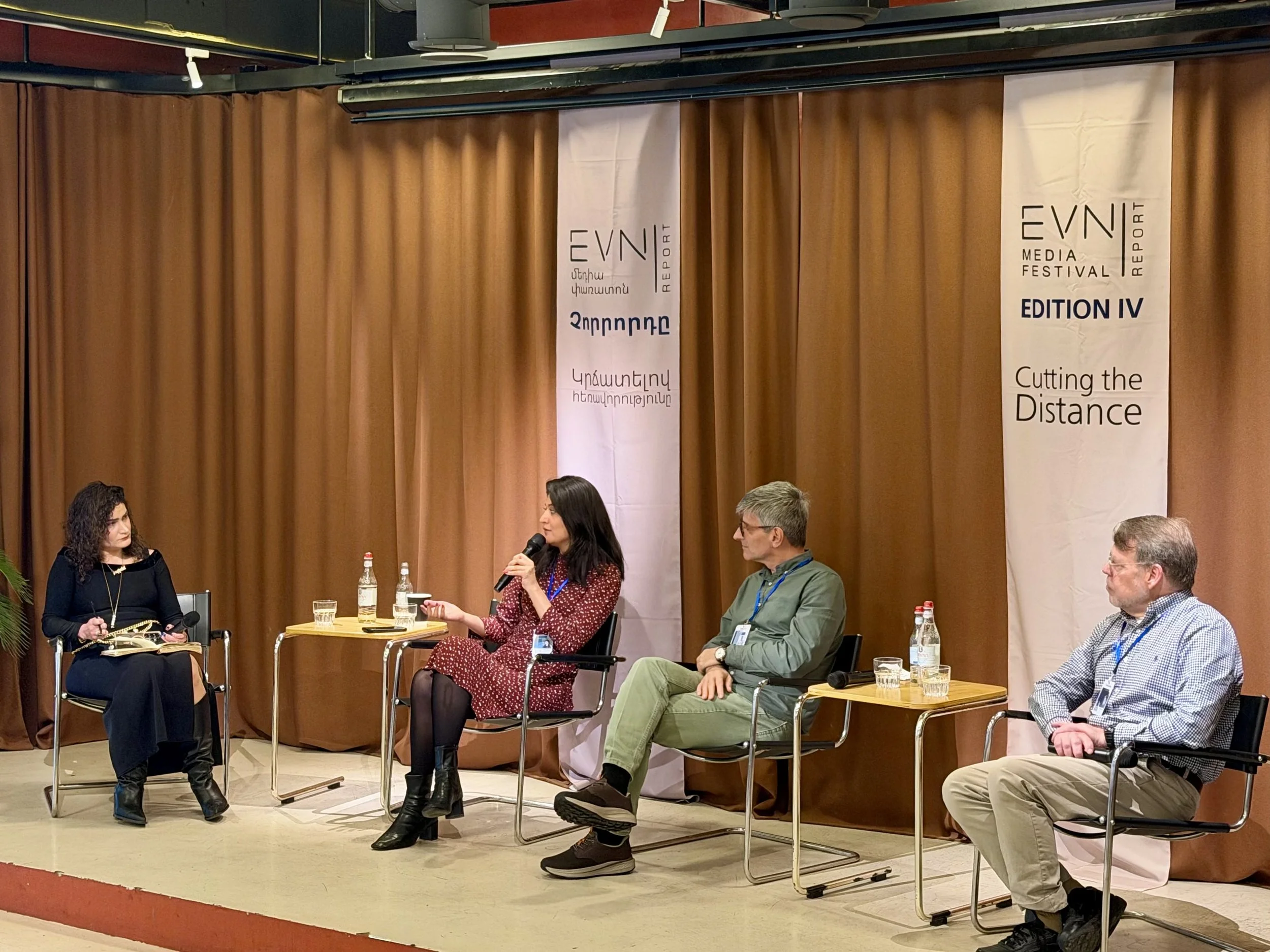
Tatiana Avedissian moderates the panel discussion How Solutions Journalism Can Change the Story. Seated across from her are Meenal Thakur, an international media development professional; Harutyun Mansuryan of Armenia’s Hetq Media Factory; and Shawn McIntosh, a journalism educator (from left to right).
YEREVAN, Armenia — November 26, 2026 — The Armenia Project (TAP) played a prominent role supporting the fourth EVN Media Festival, held November 20–22 in Yerevan, for the first time supporting discussions on solutions journalism and on censorship at a time of mounting political, technological and economic pressure on independent media worldwide.
The three-day festival, organized by EVN Report, brought together an international roster of journalists, researchers, technology experts and media professionals, including The New Yorker staff writer Raffi Khatchadourian, Citizen Lab founder Ron Deibert, Mozilla Chief Technology Officer Raffi Krikorian, and journalist and publisher, Nicolas Niarchos.
TAP's contribution centered on two complementary discussions: a public panel examining whether journalism can move beyond documenting problems to investigating solutions, and a private, breakfast roundtable exploring the increasingly complex pressures on media freedom and financial sustainability.
Both were moderated by Tatiana Der Avedissian, a TAP board member and international communications and sustainability expert, whose questions connected Armenia’s particular challenges to wider debates about democratic accountability, information integrity and the changing relationship between journalism and its audiences.
Beyond the headlines: Can journalism help solve problems?
The panel, How Solutions Journalism Can Change the Story, brought together Meenal Thakur, an international media development professional; Shawn McIntosh, a journalism educator; and Harutyun Mansuryan of Armenia's Hetq Media Factory.
The discussion challenged a familiar assumption: that journalism's principal responsibility ends with exposing wrongdoing or documenting crises. Participants examined the growing international movement toward solutions journalism, an evidence-based approach that investigates how societies respond to problems, what works, what fails and what lessons can be applied elsewhere.
“We have to inform the public - this is our job. Frankly, it's not enough,” said McIntosh, who leads the Center for Excellence in Journalism at the American University of Armenia. “People can get information so many places now. We have to engage the public too.”
Examples ranged from Ukrainian reporting on community resilience during wartime to Armenian investigations into nuclear waste, environmental challenges and public infrastructure.
“When we practice journalism, whatever kind of journalism, the intention is to hold power to account,” Thakur said, explaining how reporting on successful responses to public problems can increase pressure on authorities elsewhere to act. “If they can do it, why can't you do this for us?”
The panel also confronted the intellectual and ethical difficulties of the approach. Can journalists investigate solutions without becoming advocates? Can constructive reporting retain the skepticism essential to independent journalism? And can it help restore public trust without becoming another vehicle for corporate public relations?
Der Avedissian pressed participants on these questions, as well as the implications of artificial intelligence, the economics of news production and the risk that ostensibly positive reporting could obscure important-yet-uncomfortable truths.
Mansuryan emphasized the distinction between solutions journalism and public relations. “It's not about promises. It's about evidence. It's about facts. It's about critical thinking,” he said.
A central conclusion emerged: solutions journalism is not a new concept and should not replace investigative reporting or become a euphemism for good news. Rather, it can extend journalism's traditional accountability function by asking not only what has gone wrong, but what can realistically be done about it. The conversation also explored how AI might help journalists research and develop stories while underscoring the continued importance of human judgment, verification and reporting from the ground.
Press freedom in an age of invisible pressures
At a separate breakfast roundtable on November 22, moderated by Der Avedissian under the Chatham House Rule, participants examined the evolving meaning of censorship and the difficult economics of independent journalism.
The discussion began with Armenia itself, with participants describing a gap between formal legal protections for the press and the practical pressures experienced by journalists. Participants considered the power of social media algorithms to determine which stories receive attention, the influence of technology companies over public debate, and the extent to which advertisers, political patrons and international donors can shape the fate of the survival of a newsroom. A particularly lively exchange concerned whether censorship should be defined narrowly as state coercion or understood more broadly to encompass the economic and technological forces that determine what the public sees and hears. The financial vulnerability of independent media emerged as an equally urgent concern. Participants discussed shrinking international assistance, the retreat of major donors, politicized advertising markets and the limited prospects for subscription-funded journalism in smaller economies such as Armenia.
These pressures raised a paradox: international funding can help protect editorial independence, but dependence on foreign donors can introduce vulnerabilities of its own.
Rather than producing easy answers, the discussion highlighted the importance of distinguishing among different threats to journalism while recognizing how frequently they reinforce one another, and how countries around the world are not equally suffering from universal challenges.
Connecting Armenia to the world's most consequential media debates
For TAP, participation in the festival reflected a broader ambition: to ensure that Armenia is not merely the subject of international reporting, but an active contributor to the global conversation about journalism, democracy and the information environment.
The questions raised in Yerevan are universal. News organizations everywhere are confronting declining trust, fragmented audiences, technological disruption and uncertain business models. Armenia offers a particularly interesting setting in which to examine these challenges, given its relatively small but developing and dynamic media market, complex political environment and exposure to regional and global geopolitical pressures.
TAP’s work seeks to connect these local realities with international expertise and professional networks, while strengthening the capacity of Armenian journalists and communications professionals to engage global audiences.
Through its journalism internships, media training, international partnerships, reporting initiatives and public discussions, TAP is investing in a communications ecosystem capable of producing credible, sophisticated and internationally relevant work.
Its involvement at the EVN Media Festival builds on a growing program of high-level exchanges, including discussions at the Concordia Annual Summit, periodic webinars, workshops with visiting journalists, internships, and collaborations with academic and media institutions.
As journalism confronts profound changes worldwide, TAP intends to remain an active participant in those debates, bringing international perspectives to Armenia, helping Armenia voices reach wider audiences and contributing to a stronger, more resilient information environment.
About The Armenia Project
The Armenia Project is a nonprofit educational organization dedicated to advancing Armenia’s democratic and economic development by enhancing its communications ecosystem. Through storytelling, media engagement, and global partnerships, TAP brings international attention to urgent challenges while empowering civil society.
